
Education Partnerships for Progress
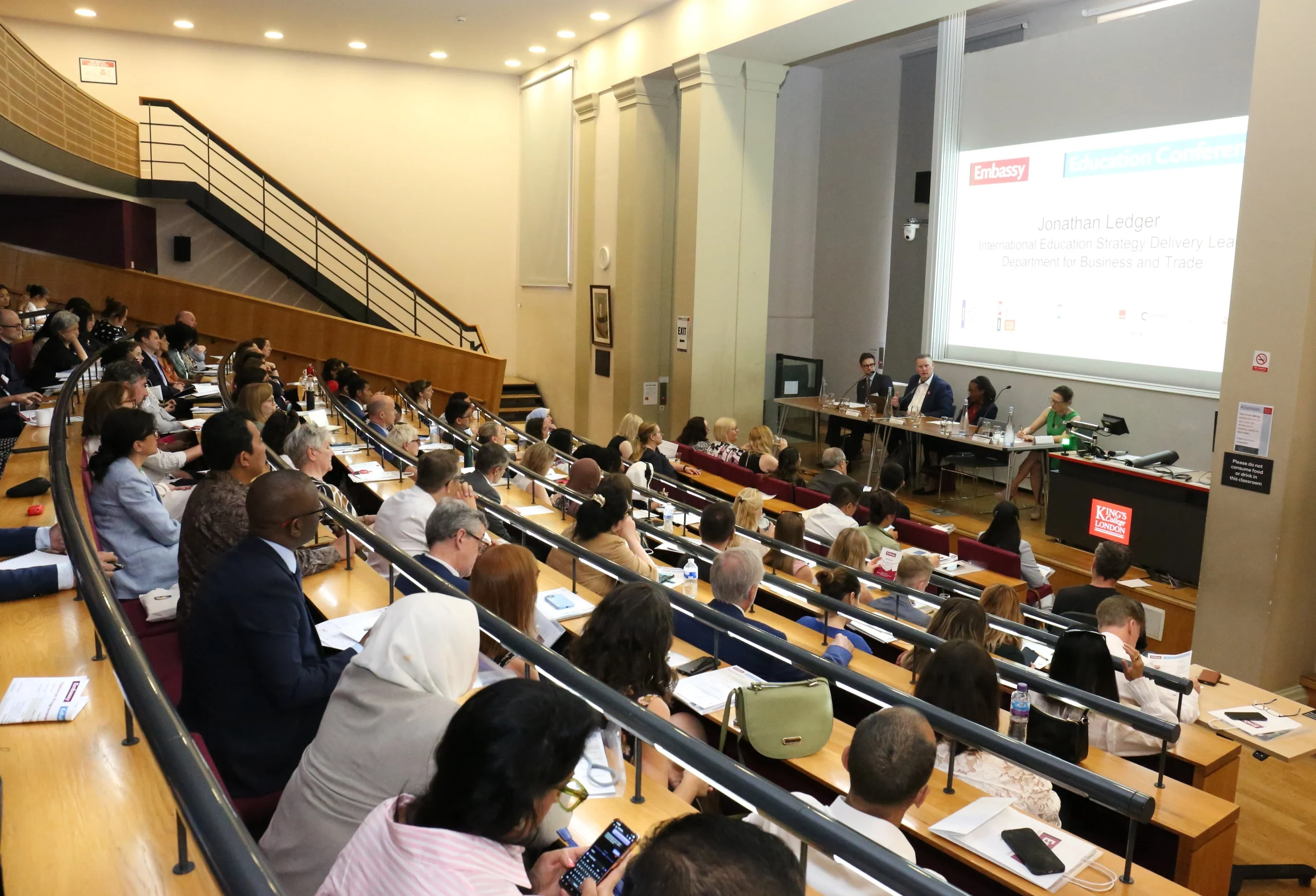
This year’s Embassy Education Conference explored the potential of the International Education Strategy in forging stronger global partnerships
“Progress comes through partnership” – with those words Dr Ros Lynch, Deputy Director (Education) at the Department for Business and Trade, opened the Embassy Education Conference on 7 July at King’s College London.
The theme of this year’s conference was the UK International Education Strategy: Partnership for Progress. Education attachés from 100 nations attended for a day of information gathering and exchange, meeting key contacts in Government, the education sector and fellow diplomats.
In her opening remarks, Dr Lynch said: “When countries look to transform skills systems, modernise universities, improve workforce productivity, strengthen innovation ecosystems or equip young people for the future economy, they increasingly look to international partnership – and increasingly, they look to the UK.”
Joining Dr Lynch in the opening plenary was Jonathan Ledger, the International Education Strategy Lead at DBT who told diplomats that “the global appetite for partnership with the UK has never been stronger… Our ambition is to be your partner of choice: working with governments, employers, institutions and investors; sharing expertise; and co-designing sustainable solutions that reflect your priorities.”
Offering a perspective from the Higher Education sector was Harry Anderson, Deputy Director at Universities UK International (UUKi). Referring to a global context that was contested and challenging, Mr Anderston said “education allows for deeper and stronger connections that open channels for cooperation”. But he warned that for the UK to continue to be a leader in international education, it needed to remain a top study destination for international students. “Signalling matters…communities need to fully understand the positive contribution of international students to our towns and cities.”
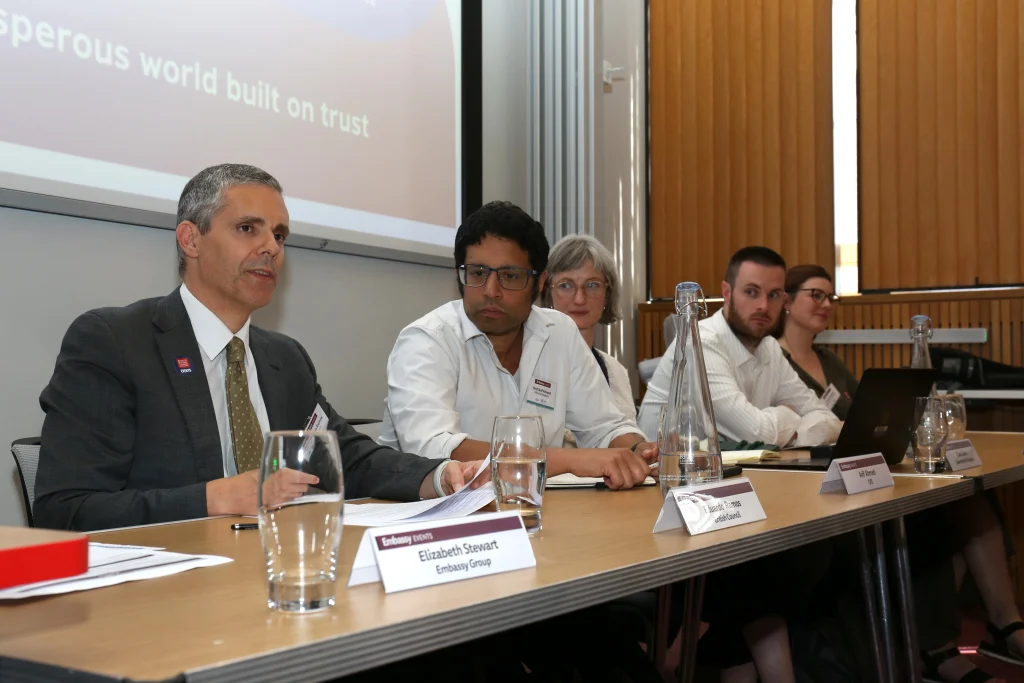
Eduardo Ramos (British Council), Arif Ahmed (Office for Students) and Clare Colvin, Dan Collet and Emma Shovlin (Department for Education) provided education attachés with an introductory overview of UK Higher Education Landscape – Institutions, Regulation and Policy
Topical themes
This year the conference included a wide range of sessions bringing together key stakeholders in the UK education sector and government to explore topical themes on international education. These included:
- Introduction UK Higher Education Landscape: Institutions, Regulation, Policy – an overview for new education attachés featuring an introduction to UK HE Institutions (Eduardo Ramos, British Council); an overview of Regulation of HE in England, focusing on Academic Freedom and Freedom of Speech (Dr Arif Ahmed MBE, Office for Students); Policy Focus on International Education Strategy (Clare Colvin, Dan Collet and Emma Shovlin, Department for Education)
- Science Diplomacy and R&I Collaboration: Horizon and Beyond – featuring an overview of UK Science Diplomacy activities (Ruth Cooper, Royal Society); the role of the Science and Technology Network (Frazer Macdonald, DSIT); and an introduction to research collaboration through Horizon Europe (Perry Guess, UKRI)
- Trans-National Education – Equitable Access and Quality Assurance (Krisztina Ford, QAA); Global Education and Technology – Insights into Transnational Student and Staff Experiences (Sarah Knight and Paola Marchionni, JISC); Pathways to TNE Partnerships – Case Studies (Andrew Straughan, NCUK)
- Scholarship Programmes – with Chevening (Andrew Chadwick, FCDO), Commonwealth Scholarships Commission (Nathan Haigh, ACU) and accessing Institutional Scholarships (Hailing Harper, UCAS)
- Education and Training for Employability – a UK policy overview on Lifelong and Modular Learning (Laurence Kavanagh, Department for Education); Building Inclusive Skills Models for workforce development (Jane Rexworthy Whitehart OBE, UK Skills Partnership); Higher Education for Graduate Employability – an HE Provider Perspective (Hannah Atkins, IHE)
- Student Mobility and Exchange Schemes – Overview and context provided by Iona Murdoch of UUKi; Erasmus+ Policy and Strategy Overview (Sam Herman-Wilson, Department for Education, EU and Erasmus+ Unit); and Erasmus+ Implementation (Eduardo Ramos, British Council)
- Navigating AI in Higher Education: Capability, Confidence and Leadership – (Sarah Knight and Paola Marchionni, JISC)
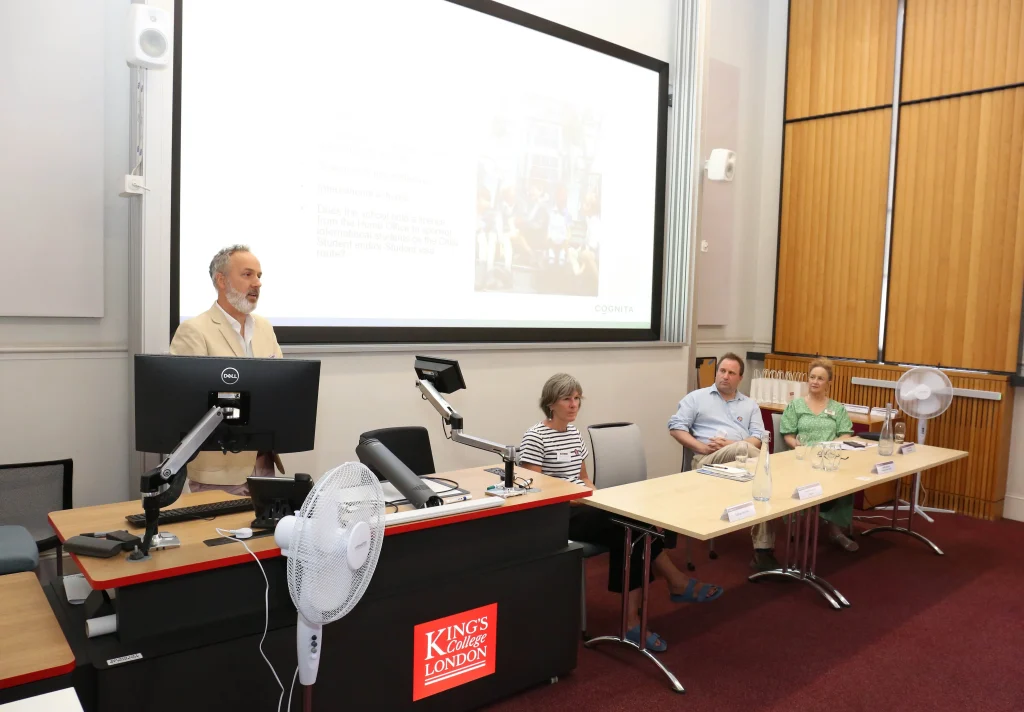
Diplomatic spouses attend a panel discussion on schooling in England, featuring (from left) Neil Herrington (Cognita), Siobhan McGrath (Southbank International) and Habib Maroon, Kensington Park School)
Education for Diplomatic Families
A separate conference programme for diplomatic families included sessions to assist diplomats, diplomatic spouses and children with their education choices, including schooling and post-18 education.
The schooling session featured a comparison between State and Independent schools, curricula and key stage comparisons, plus an overview of the types of independent schools available to diplomatic children.
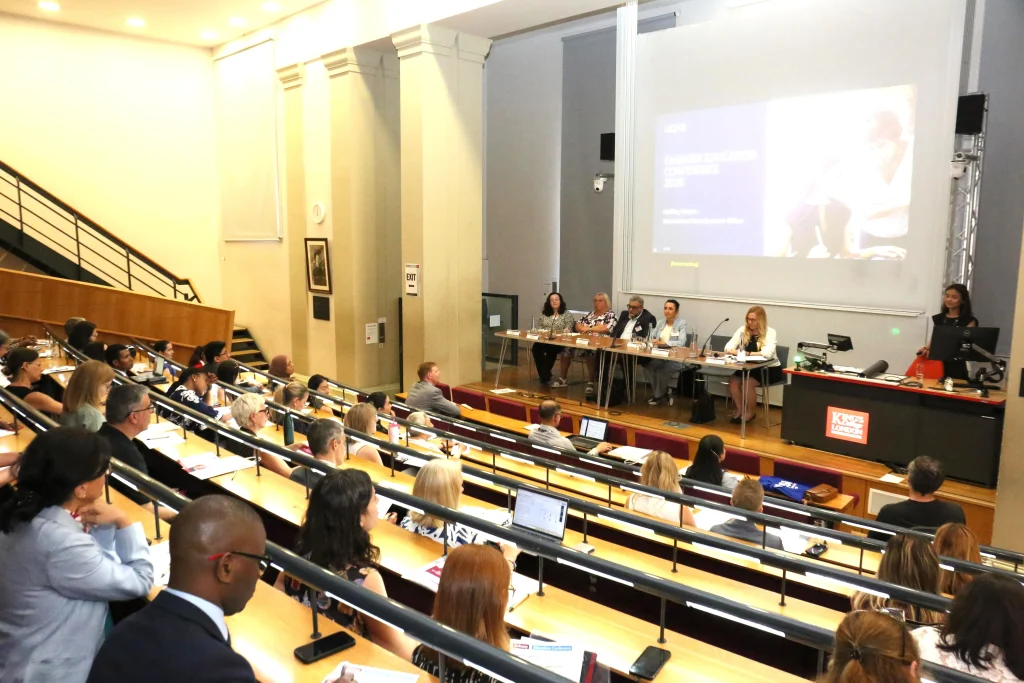
Offering guidance on accessing higher education in the UK were (from left): Kay Stones, Sally Bellamy and Tanup Gadhia (UK Visas and Immigration), Dr Suzanna Tomassi (NCUK) and Hailing Harper (UCAS)
Education attachés and diplomatic dependants attended a joint session on Accessing Higher Education in the UK, which featured an overview of UK admissions procedures (Hailing Harper, UCAS); International Student Visas (Sally Bellamy, Kay Stones of UKVI); and Pathway Programmes (Dr Suzanna Tomassi, NCUK).
Tanup Gadhia offered diplomatic families a useful guide on immigration rules governing diplomatic dependants over the age of 18 in fulltime education, and options at the end of a diplomatic posting should they need to switch their immigration status in order to remain in the UK to complete their education.
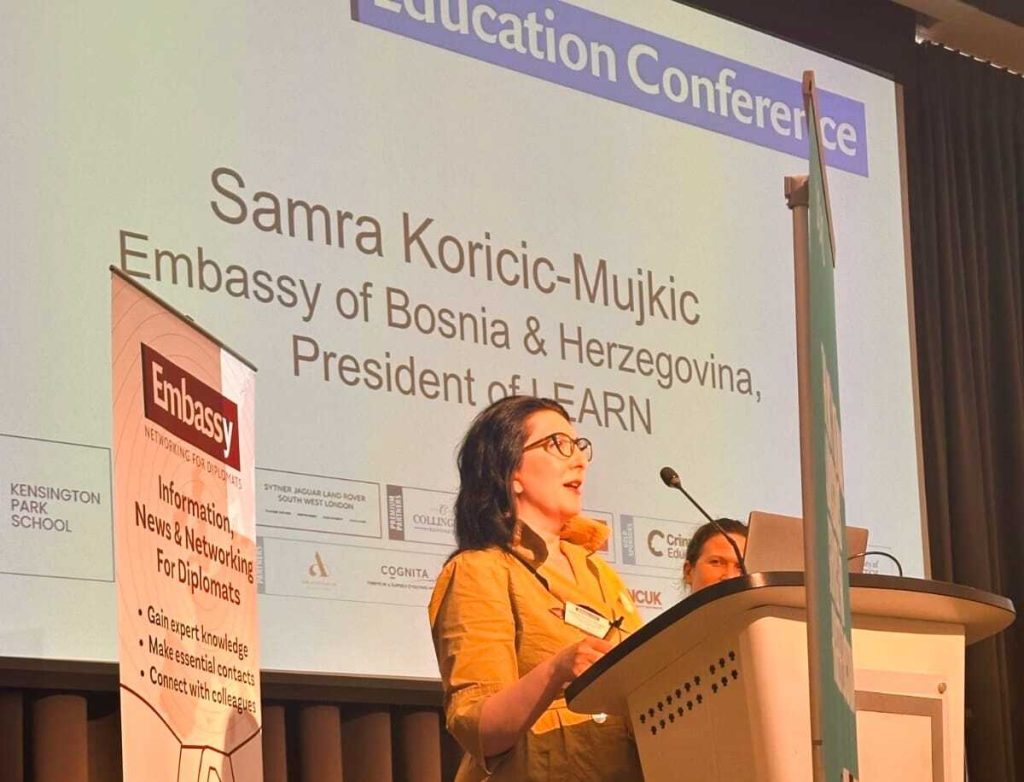
LEARN President Samra Koričić Mujkić of the Embassy of Bosnia Herzegovina closes the conference with a powerful message on the importance of education diplomacy
Education Diplomacy: a tool for peace
Providing the closing remarks for the conference was President of LEARN Samra Koričić Mujkić of the Embassy of Bosnia Herzegovina. Drawing on the experiences of her country – and for all children caught up in conflict and attending ‘war schools’ in bunkers and basements – she made an impassioned plea to attendees: “Let us use our networks – LEARN among them – not merely to exchange courtesies, but to genuinely advance education and cultural diplomacy as tools of peace. Let us remember that behind every treaty and every conflict are children who will inherit whatever we build, or fail to build, today.”
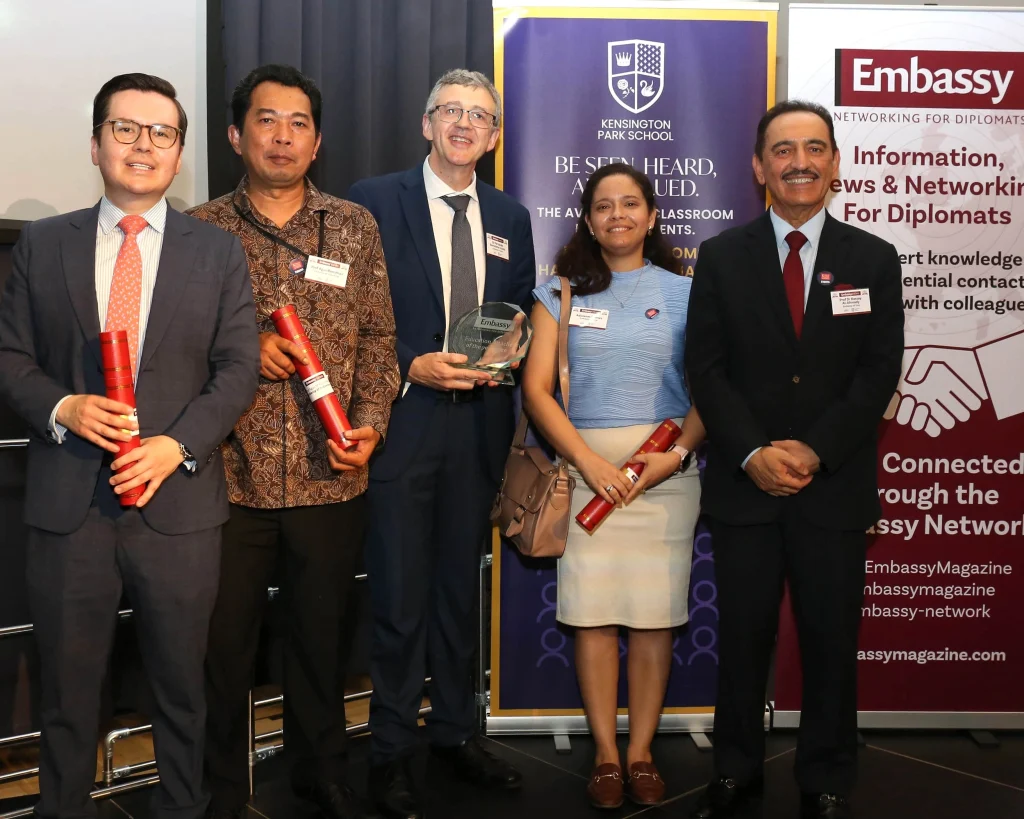
Winners of the Embassy Education Awards 2026: Education Attaché of the Year 2026, Dr Fernando Bartolomé, Embassy of Spain (centre), with regional winners (from left) Jorge Enrique Córdoba-Currea (Embassy of Colombia); Prof Agus M Ramdhan (Embassy of Indonesia); Adislenes Runes César (Embassy of Cuba); and Prof Dr Kossay Al-Ahmady (Embassy of Iraq)
Embassy Education Awards
The Embassy Education Conference concluded with the Embassy Education Awards to recognise the excellence in education diplomacy. Diplomats and education and cultural officers were honoured for their contribution to enhancing education and research ties with the UK and for their efforts to support their international students studying in the UK.
The winner was voted for by the diplomatic and education community, out of a shortlist of regional finalists who had been selected by an independent Embassy Education Awards Judging Panel.
The Education Attaché of the Year 2026, as voted for by the diplomatic and the education community, was the Education Attaché of the Year for Europe, Dr Fernando Bartolomé from the Embassy of Spain, for his inspirational campaign to promote foreign language learning in the UK.
Congratulations also go to the other regional winners for their remarkable work in promoting stronger education and research partnerships with the UK:
- Education Attaché of the Year for The Americas, Mr Jorge Enrique Córdoba-Currea, Embassy of Colombia
- Education Attaché of the Year for Asia, Prof Agus M Ramdhan, Embassy of Indonesia
- Education Attaché of the Year for The Caribbean, Mrs Adislenes Ruenes César, Embassy of Cuba
- Education Attaché of the Year for the Middle East, Prof Dr Kossay Al-Ahmady, Embassy of Iraq
Share this story


